
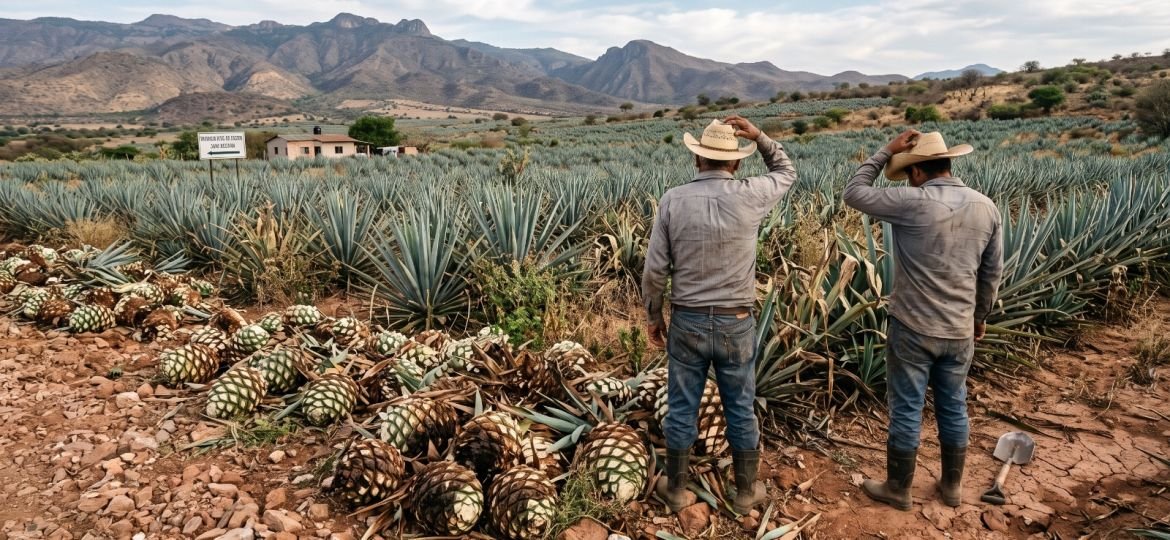
The tequila agro-industry is facing one of the most challenging moments in its production cycle. Driven by the export boom of the last decade, the indiscriminate planting of Agave tequilana Weber variedad azul unleashed an unprecedented market saturation nationwide, exposing a structural imbalance that directly impacts the rural farming economy and local ecosystems.
According to sector records and the Consejo Regulador del Tequila (CRT), the cultivated area grew rapidly, reaching hundreds of thousands of hectares within the Appellation of Origin (Denominación de Origen) zone. This phenomenon, rooted in the economic model of cyclical mismatch between supply and demand, triggered a steep collapse in raw material prices, shifting from a boom to massive losses. This was evidenced by prices dropping from a commercial peak of over 30 pesos per kilo to a mere one to four pesos per kilo in the field.
With maintenance costs accumulating over the five to seven years it takes the plant to mature, current sales do not even cover the operational costs of jima (harvesting) and freight for small independent producers, favoring only certain tequileras with stockpiling capacity and vertical integration.
The Necessary Shift in Approach
The initial financial appeal displaced traditional crops like corn, beans, and vegetables, compromising food self-sufficiency in rural municipalities across Jalisco, Guanajuato, and Michoacán.
Today, faced with the economic unviability of harvesting, thousands of plots are being abandoned. Family producers face mounting debt with agricultural financiers or intermediaries, forcing them into labor migration or renting out their land at punishingly low prices. The lack of widespread contract farming schemes has left agricultural workers unprotected against industrial volatility.
The expansion of the agave frontier has left severe ecological consequences, documented by the Ministry of Environment and Territorial Development (SEMADET) and research centers like INIFAP. These include:
- Deforestation and land-use change: Thousands of hectares of forest and selva baja caducifolia (tropical dry forest) were logged or burned to make way for commercial plantations.
- Erosion and pests: The intensive practice of monoculture accelerated soil degradation and triggered the proliferation of pests such as the picudo del agave (Scyphophorus acupunctatus) and rot bacteria, requiring an increasing use of agrochemicals.
- Waste and regulation: The annual generation of over 700,000 tons of bagazo (agave pulp waste) and millions of liters of vinazas (liquid waste) places immense pressure on hydrological basins. Despite certifications like ARA (Agave Responsable Ambiental) aimed at halting deforestation, damage to unregulated soils remains active.
This current juncture demands binding territorial planning between the government and the industry, transitioning from an extractive and speculative model toward strict regulation of cultivable hectares and productive diversification. Achieving this requires close coordination and collaboration among producers, tequileras, and authorities. The approach must pivot toward generating shared profits while safeguarding one of the most robust agro-industries in the country.
