
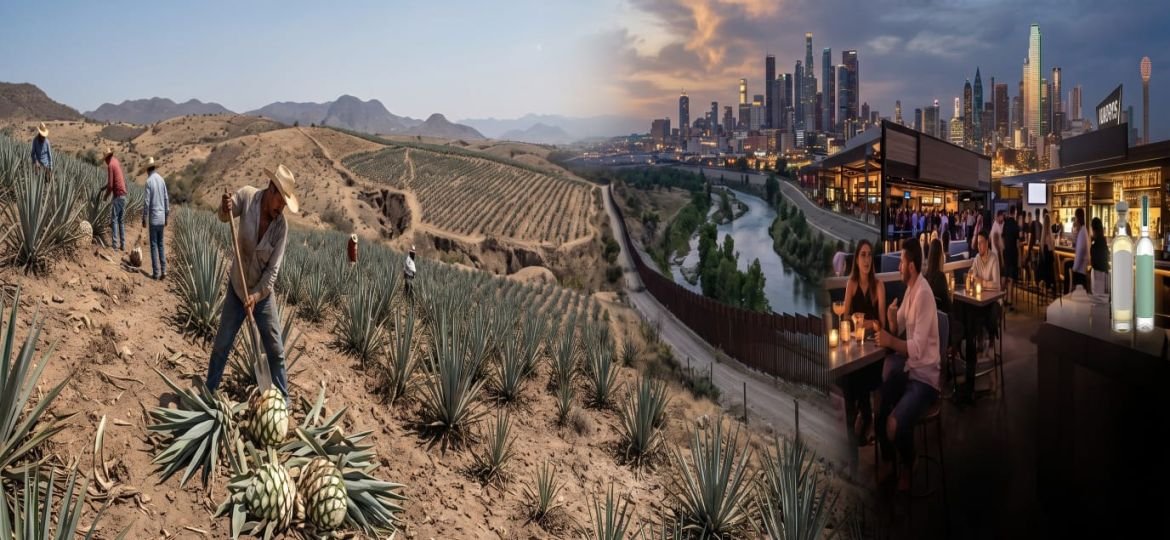
U.S. drinkers are now choosing tequila and mezcal over domestic whiskey, fueling industrial monoculture, ecological risk, and staggering inequity for rural jimadores.
Washington / Mexico City. The American bar scene is undergoing a profound cultural and commercial shift. For the first time in modern history, Americans are drinking more tequila and mezcal than domestic whiskey, downing nearly 300 million liters of agave spirits each year. Once relegated to budget party shots, agave has climbed to the top shelf: high-end labels are flourishing, and premium pours now fetch up to $60 a glass in major urban centers. Yet, behind this multimillion-dollar boom lies an unsustainable paradox that threatens to dismantle the very ecological and ancestral foundations of Mexico’s native spirit.
During a presentation at the Mexican Cultural Institute in Washington, veteran restaurateur David Suro Piñera and renowned ethnobotanist Gary Paul Nabhan—authors of Agave Spirits: The Past, Present and Future of Mezcals—sounded the alarm on what rapid industrialization is doing to the trade. Unlike spirits made from uniform cereal mashes or neutral grain botanicals, traditional Mexican agave spirits represent an unrivaled biodiversity matrix: more than 50 distinct species and 60 varieties of agave, fermented alongside thousands of wild yeast strains and native bacteria tied to regional microclimates and heritage clay vats.
However, market pressure and rigid Appellation of Origin regulations have stripped this ancestral complexity down to bare-bones industrial homogeneity. In an effort to maximize yield and lock down trademark boundaries, modern tequila farming has abandoned genetic diversity in favor of monoculture clones of blue agave (Agave tequilana). As Nabhan observed, the current landscape is akin to entering a modern art gallery where every single wall hangs the exact same Andy Warhol self-portrait: efficiency has completely overshadowed the collective artistry that once defined Mexican mezcaleros.
The ecological fallout of this genetic bottleneck is severe. Having co-evolved within harsh arid ecosystems over 11 million years, wild agaves developed sophisticated natural defenses against disease. Mass cloning neutralizes that evolutionary armor, leaving plantations vulnerable to blight and forcing growers to rely heavily on chemical fertilizers and pesticides. Today, approximately one-third of wild agave species face extinction risks as industrial farming encroaches on native habitats, disrupting vital relationships with natural pollinators such as nectar-feeding bats.
Equally stark is the human disparity underpinning the billion-dollar trade. While an agave-forward margarita easily commands $17 at an American cocktail lounge, the jimadores—the skilled field laborers who spend dawn-to-dusk shifts wielding heavy coas and chopping agave plants up to 800 times an hour—receive less than a penny of that revenue. A harvested ton of agave yields thousands of drinks, yet the field crew splits an average of just $25 per ton. This staggering wage gap leaves bartenders across the border earning far more in single tips than the artisans extracting the raw material earn for backbreaking manual labor.
In response to this ecological and labor crisis, a growing vanguard of scientists, independent distillers, and indigenous producers is pushing for regenerative reform. By encouraging bat pollination and replanting agaves from wild seed stock rather than laboratory clones, they are fighting to restore biological resilience to the fields. For Suro and Nabhan, preserving this 2,500-year-old “liquid art” requires a radical shift away from unchecked corporate extraction, putting generational wisdom, equitable wages, and environmental stewardship back at the heart of every bottle.
