
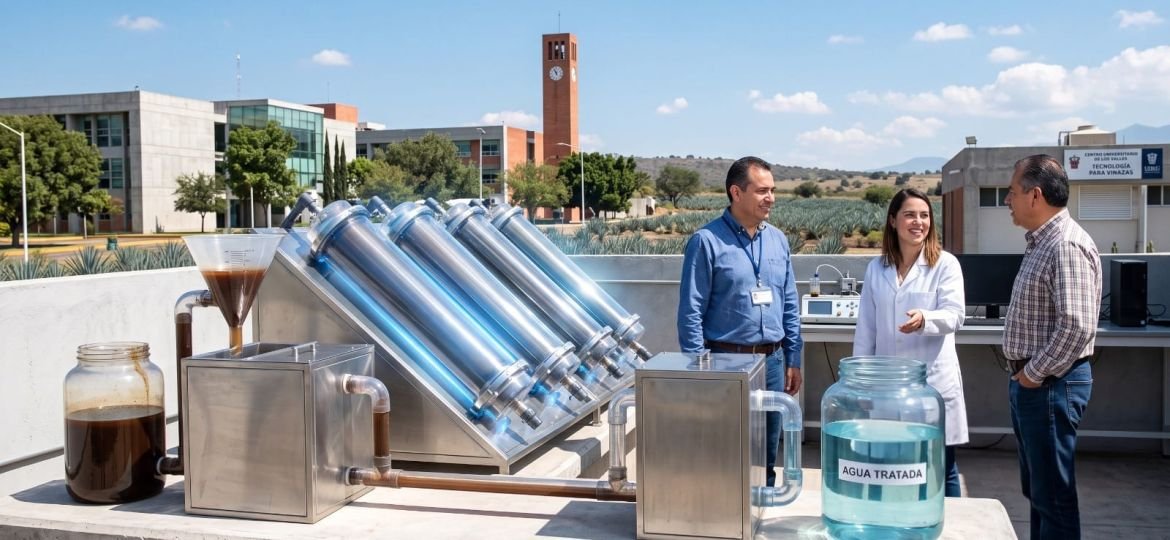
The tequila industry faces a critical environmental challenge: for every liter of tequila produced, between 10 and 15 liters of vinaza are generated—a waste byproduct up to 100 times more polluting than domestic wastewater. In response to this issue, researchers from the Centro Universitario de los Valles (CUValles) at the Universidad de Guadalajara have developed pioneering technology to treat these effluents.
The system integrates physicochemical stages and solar photocatalysis assisted by titanium dioxide. Utilizing reactors equipped with solar tracking and smart sensors, the process breaks down complex organic compounds in just a few hours, allowing the treated water to be safely reused for agricultural and irrigation activities.
The project, which already holds one granted patent and has another pending, stands out as a cost-effective and accessible solution, primarily focused on empowering small and medium-sized tequila producers in Jalisco. The university team is currently collaborating with regional businesses to deploy pilot plants.
This innovation not only mitigates the ecological impact of Mexico’s iconic spirit, but also reinforces the vital role of public universities in technology transfer and in solving environmental challenges within the productive sector.
