
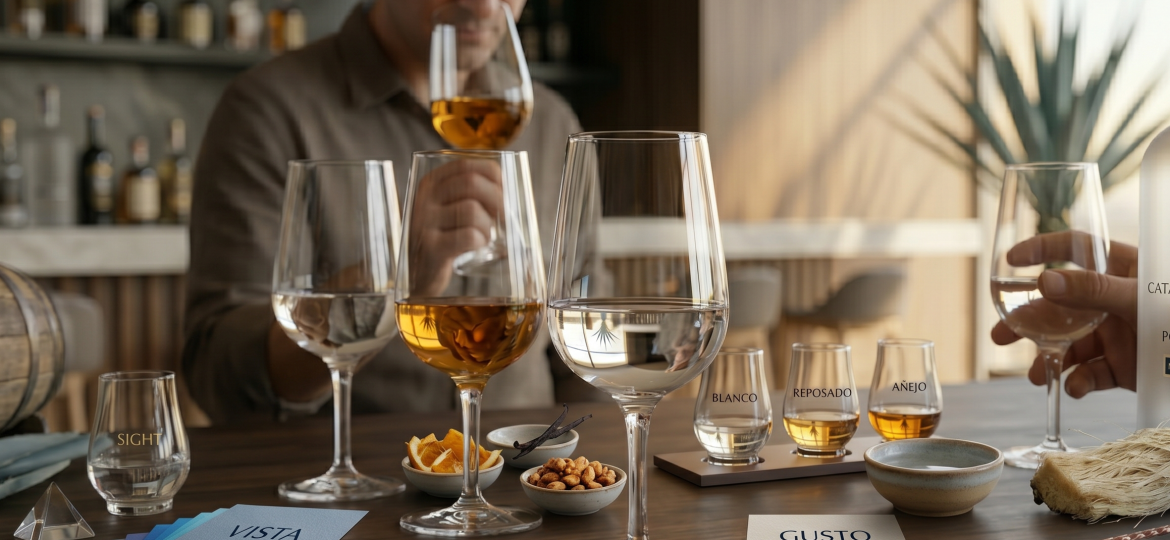
Four Senses, Infinite Possibilities
By Dr. Tequila – Criterio Tequilero
Tasting tequila is not a ritual reserved for the initiated. It doesn’t require an arcane vocabulary or years of formal training. It requires attention, curiosity, and a method to organize what your senses already know how to do. Dr. Tequila is convinced that anyone can develop sensory judgment (criterio) if they learn to listen to what their glass has to say. Here is what you need to know to get started.
The Four Dimensions of Tasting
Any serious sensory analysis of a tequila passes through four dimensions: sight, smell, taste, and aftertaste. Each provides different information, and none can replace the others. Skipping one is like reading a book from the middle: you might understand something, but you miss the context that gives it all meaning.
- Sight evaluates transparency, clarity, and color. A cloudy tequila may indicate a problem with the process or preservation. Color speaks to the time spent in the barrel and the type of wood: a light golden hue suggests a young barrel or a short reposo; a deep amber indicates prolonged maturation or a barrel that yields color quickly. Cristalinos, as we’ve seen, intentionally break this logic.
Smell: Where Everything Begins
The sense of smell is the most informative dimension and, simultaneously, the most undervalued by the average consumer. Most people smell the glass for a second and drink. A taster who wants to learn lingers there much longer.
A practical tip: Between samples, smell your own forearm to “reset” your perception. Your skin has a neutral, familiar aroma that resets the senses better than any other resource. You can also apply slight pressure to the sides of your nostrils during the first inhalation; it activates the receptors in a different way.
The notes you look for in the nose are organized into families:
- In a Blanco: Cooked agave (sweet, honeyed), mineral (pepper, rose), citrus—don’t just say “citrus,” specify if it’s Persian lime, orange, tangerine, or grapefruit—and green (herbal, vegetal).
- In aged expressions: Add to those families wood (oak, cedar), sweet (vanilla, toffee, caramel), fruit (grape, apple, cherry), and spice (cinamon, clove, black pepper).
Developing a Vocabulary: The Sensory Library
The biggest barrier to tasting well is not a lack of sensory talent: it’s a lack of vocabulary. Aromas we cannot name are perceived, but we cannot communicate or remember them with enough precision to compare them.
The most accessible training requires no professional kit. Next time you go to the market, stop at the fruits and smell them one by one. Not the bag: the individual fruit. Distinguish between the aroma of a Persian lime and an orange. Between a green apple and a ripe one. Between a mango and a guava. Every aroma you learn to name becomes a reference your mind will automatically use when it encounters it in a glass.
A note worth mentioning: Women have a documented biological advantage in detecting and classifying aromas. They detect more nuances and link them with greater speed. In any serious evaluation panel, the female presence is not a gesture of inclusion: it is a methodological asset.
Taste: Zones, Timing, and Sensations
When drinking, taste buds do not all work the same way or at the same time. Different areas of the tongue have different sensitivities: sweetness is detected first at the tip, saltiness and acidity on the sides, and bitterness at the back. A complex tequila passes through all these zones, leaving information in each.
What to look for in the taste:
- Balance: Is there harmony between the notes?
- Integration: Does the alcohol burn or integrate? A very obvious alcoholic sensation usually indicates under-maturation or a less refined distillation process.
- Off-notes: Metallic notes (distillation issues), soapy notes, or intense bitter citrus (overproduction of esters, fermentation defects). If you find these, it’s not subjectivity: it’s evidence of a process problem.
The Aftertaste: The Final Verdict
The aftertaste—or finish in spirits vocabulary—is the duration and intensity of the profile that remains in the mouth and throat after swallowing. For many experienced tasters, it is the most reliable indicator of quality and complexity.
A short, clean finish may be desirable in a light blanco designed for cocktails. But in an añejo or extra añejo, a brief finish usually indicates limited depth. The best aged tequilas have an aftertaste that extends for more than a minute, shifting notes as it persists: first the sweetness, then the wood, then the spice, followed by a slight mineral note that closes cleanly.
Temperature Matters More Than You Think
One final piece Dr. Tequila needs you to know: temperature radically affects how you perceive flavors. Excessive cold “numbs” the tasting properties; in particular, it mutes bitter and vegetal notes. This is why very cold drinks allow for higher consumption without the palate protesting. It’s not that they have less alcohol; it’s that the cold masks it.
To appreciate a tequila in its full dimension, the ideal temperature is between cool and room temperature. Not frozen, not warm. A complex añejo at the right temperature will tell you things it would never reveal submerged in a glass of ice.
Now you have the method. The rest is practice, patience, and many glasses enjoyed well—and celebrated responsibly. Welcome to criterio tequilero.
Dr. Tequila – Criterio Tequilero
